

What Is GEO (Generative Engine Optimization)? And How Is It Different from SEO?
Type a question into Google today and there's a good chance you get your answer before you ever click a link. Google's AI Overview sits right at the top of the page, ChatGPT and Perplexity are becoming default research tools for millions of people, and increasingly, the "search result" isn't a list of blue links — it's a written answer, generated by AI, that cites (or doesn't cite) a handful of sources.
That shift has created a new discipline sitting right next to SEO: Generative Engine Optimization, or GEO.
If you've spent the last decade optimizing for Google's algorithm, GEO can feel like a new language. This guide breaks down exactly what it is, how it's different from traditional SEO, and what your brand needs to do to actually get cited inside AI-generated answers.
What Is GEO (Generative Engine Optimization)?
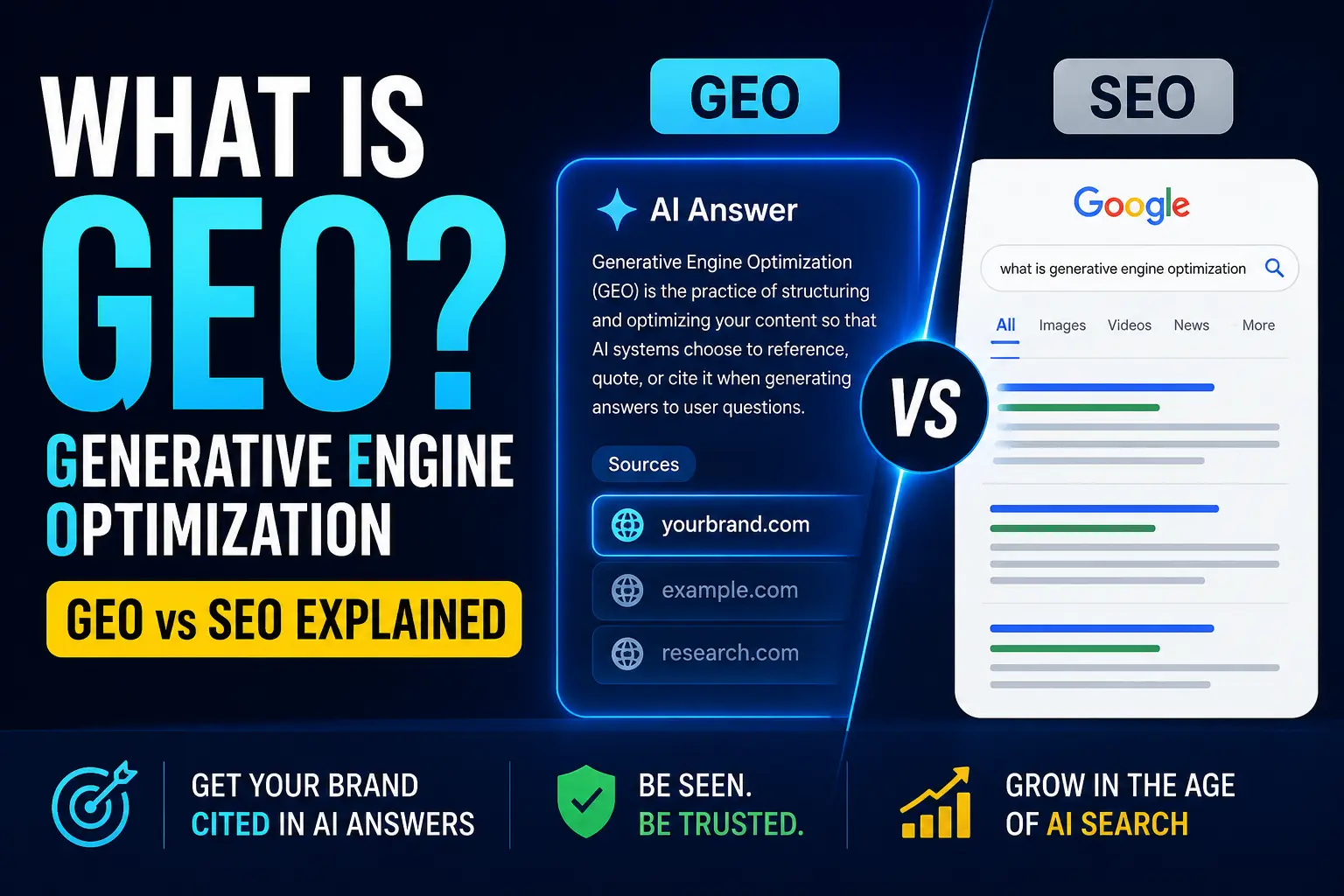
GEO is the practice of structuring and optimizing your content so that AI systems — like Google AI Overviews, ChatGPT, Perplexity, and Claude — choose to reference, quote, or cite it when generating answers to user questions.
Where traditional SEO is about ranking a page in a list of search results, GEO is about becoming part of the answer itself. Instead of asking "how do I get on page one?", GEO asks "how do I get my brand mentioned inside the response an AI gives someone?"
This isn't a replacement for SEO — think of it as the next layer built on top of it. You still need a technically sound, well-structured, authoritative website. GEO just adds a new set of considerations on top of that foundation.
Why GEO Matters Right Now
The numbers explain the urgency. Industry reporting in 2026 has pointed to Google's AI Overviews reducing traditional organic click-through rates by somewhere in the range of 18–47%, depending on the query type and industry. At the same time, research from marketing platforms has found that a meaningful share of B2B purchase research — some estimates put it near 10% of revenue — is now influenced by AI-assisted research tools rather than a direct Google search.
In plain terms: fewer people are clicking through to websites, but the ones who do click are further along in their decision and often converting at a higher rate. Meanwhile, a growing number of potential customers never click at all — they get their answer from an AI summary, form an opinion of your brand based on whether (and how) you're mentioned in it, and move on.
If your brand isn't showing up inside those AI-generated answers, you're becoming invisible to a growing slice of your audience — even if your traditional SEO rankings look perfectly healthy.
GEO vs SEO: What's Actually Different
| Traditional SEO | GEO | |
|---|---|---|
| Goal | Rank in the list of search results | Get cited/quoted inside the AI-generated answer |
| Success metric | Position #1–10, click-through rate | Citation frequency, share of AI answer "voice" |
| Content structure | Keyword-focused pages, meta tags, backlinks | Clear, extractable answers; semantic completeness; structured data |
| Ranking signal | Keyword density, backlink authority, page speed | Topical depth, original data, clear entity relationships, being quotable in short chunks |
| What engines reward | Matching a search query closely | Answering a question so clearly and completely it can be lifted almost as-is |
| Content depth | Can be split across many thin pages | Rewarded for fewer, more complete resources covering a topic fully |
| Trust signals | Backlinks, domain authority | Original research, first-party data, clear authorship, citations from other credible sources |
The core mental shift: SEO optimizes for a ranking algorithm. GEO optimizes for a reading, summarizing AI model that needs to understand your content well enough to safely repeat parts of it to someone else.
How to Start Optimizing for GEO
You don't need to throw out your SEO playbook — you need to extend it. Here's where to start:
-
Write in extractable, self-contained chunks
AI models pull short, clearly-worded passages to build their answers. Structure your content so that individual paragraphs and list items can stand alone and make complete sense without the surrounding context. Lead with the direct answer, then explain.
-
Cover a topic completely, not just a keyword
GEO rewards topical completeness over keyword density. Instead of five thin pages targeting five related keywords, publish one comprehensive resource that covers the full topic — including related questions, comparisons, and edge cases a reader (or an AI model) might have.
-
Publish original data and first-party research
AI models tend to prefer citing primary sources over content that's clearly aggregating or rewording someone else's reporting. A short original survey, a client benchmark, or a real case study is far more citation-worthy than a rewritten "top trends" roundup.
-
Use structured data (schema markup)
Structured data helps AI systems understand exactly what your content is, who wrote it, and how it's organized — reducing ambiguity and increasing the odds of accurate citation. (See the schema section below for a ready-to-use example.)
-
Build genuine topical authority with a content cluster
Publish a core pillar page on a subject, supported by several in-depth related articles that link back to it. This entity-rich structure signals depth and authority to both traditional search and AI crawlers.
-
Keep E-E-A-T front and center
Experience, Expertise, Authoritativeness, and Trustworthiness matter more, not less, in an AI-search world. Named authors, clear credentials, transparent sourcing, and consistent publishing history all help AI systems treat your brand as a safe, citable source.
GEO and SEO Aren't Competing — They're Compounding
The brands winning in 2026 aren't choosing between SEO and GEO. They're treating GEO as the next evolution of the same discipline: still built on strong technical SEO, clear site structure, and genuine expertise — just now written and structured with an additional reader in mind, one that happens to be an AI model summarizing your content for someone else.
Traditional SEO still drives the majority of high-intent traffic today. GEO is how you make sure you're not left out of the growing share of searches that never make it to a traditional results page at all.
Frequently Asked Questions
Is GEO the same as AEO (Answer Engine Optimization)?
They're closely related and often used interchangeably. AEO typically refers more narrowly to optimizing for direct-answer formats (featured snippets, voice search, AI Overviews), while GEO is the broader term covering optimization for any generative AI system, including chat-based tools like ChatGPT and Perplexity. In practice, the tactics overlap heavily.
Does GEO replace the need for traditional SEO?
No. Traditional SEO remains the primary driver of high-intent website traffic. GEO builds on top of solid SEO fundamentals — you still need good technical SEO, site structure, and backlinks. GEO adds extra structuring and content strategy to also get cited inside AI-generated answers.
How do I know if AI models are already citing my content?
Search your brand name and key topics directly in ChatGPT, Perplexity, and Google's AI Overview to see if and how you're mentioned. Some SEO platforms are also beginning to offer AI-citation tracking as a feature.
Do I need to rewrite all my old content for GEO?
Not all of it. Prioritize your highest-value commercial and educational pages first — the ones closest to your core services — and restructure those for extractability, completeness, and structured data before working through the rest of your site.