
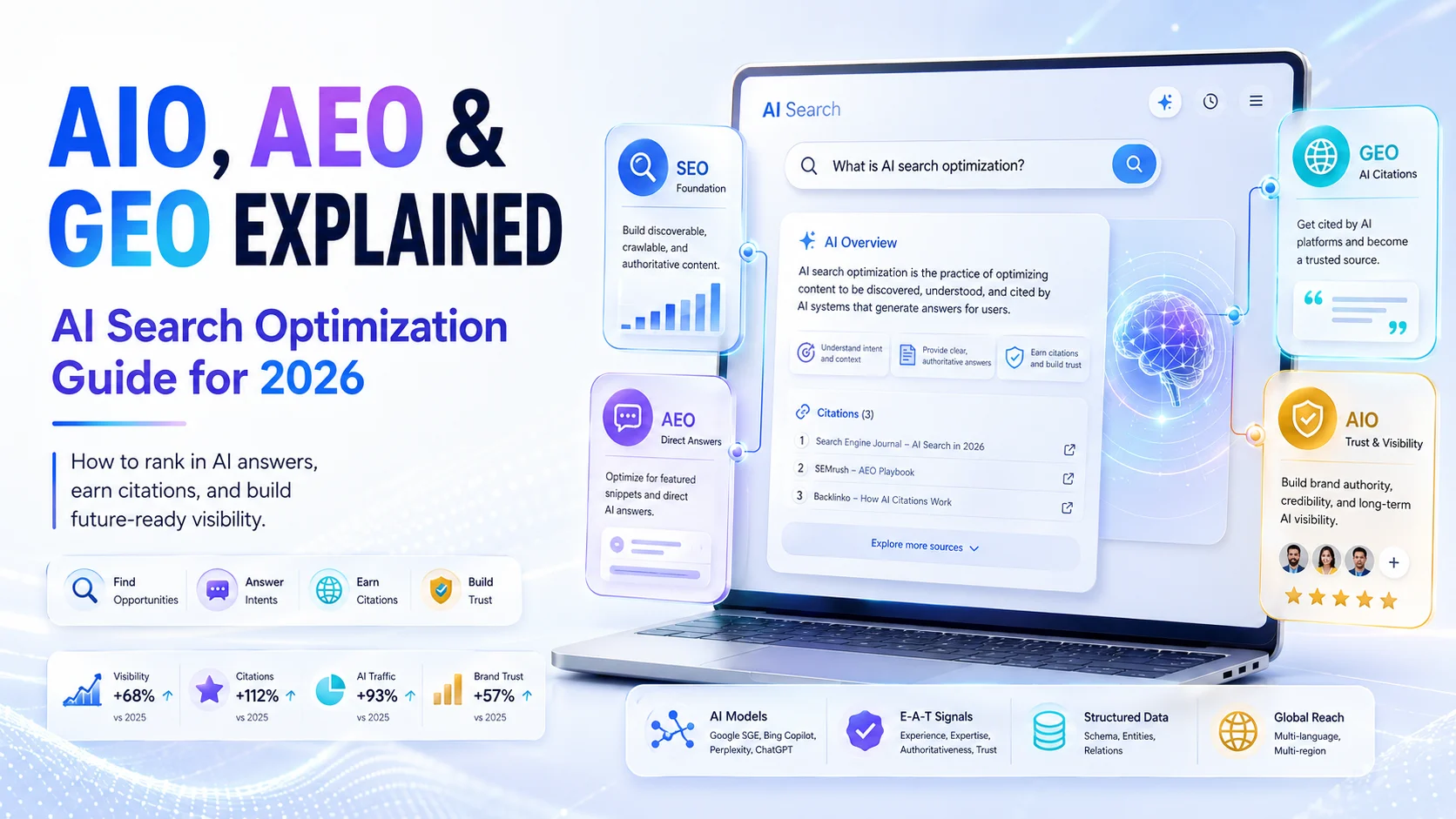

AI Search Optimization: AEO, GEO, and AIO Explained
In short: AI search optimization now runs on three connected disciplines. AEO (Answer Engine Optimization) gets your content picked as the direct answer in tools like ChatGPT and voice search. GEO (Generative Engine Optimization) gets your brand cited inside AI-generated summaries like Google AI Overviews and Perplexity. AIO (AI Optimization) is the umbrella — the ongoing work of making your brand trustworthy, structured, and recommendable across every AI system your customers use. Traditional SEO is still the foundation underneath all three. In 2026, ranking well means optimizing for all four at once.
For twenty years, "ranking on Google" was the whole game of search engine optimization. Get to page one, get the click, get the customer. That model isn't dead — but it's no longer the only model. A growing share of searches now end in a zero-click search, where the answer already showed up in an AI Overview, a chatbot response, or a voice assistant's reply. If your brand isn't part of that AI-generated answer, it doesn't matter how well-optimized your website is for traditional rankings.
That's the shift behind the acronyms marketers keep throwing around: AIO, AEO, and GEO. They sound like alphabet soup, but they map to real, practical changes in how you should be researching, structuring, and publishing content — and to how you get found in ChatGPT, Gemini, Perplexity, and Google's AI Overviews, not just in a traditional search engine. Here's what each term actually means, and how to build an AI search optimization strategy around all of them.
What Is SEO? The Foundation AI Search Is Still Built On
Search Engine Optimization is still the base layer of any AI search optimization strategy. It's about technical health, crawlability, and getting individual pages to rank in traditional search results — the "ten blue links" model. Keyword research, backlinks, page speed, mobile performance: all of that still matters, because AI systems still rely on well-indexed, well-structured websites as their raw material. AEO and GEO are built on top of SEO, not instead of it — skip this layer and the other two have nothing to work with.
What Is AEO? Answer Engine Optimization Explained
Answer Engine Optimization (AEO) is about structuring your content so it can be pulled out and used as a direct answer — whether that's a featured snippet, a "position zero" result, a voice search response, or a reply inside ChatGPT.
The core technique is answer-first writing: open with a tight, 40–60 word answer to the question at hand, then follow with the supporting detail. This serves two audiences at once — the AI systems that want a clean, quotable summary, and the human readers who want to keep reading for depth.
Practical AEO moves for better AI search visibility:
- Target conversational, question-based keywords ("what is...", "how to...", "best way to...") the way people actually type them into ChatGPT or voice search
- Structure content around real questions people ask, in clear Q&A format
- Use FAQ schema markup so search engines and AI crawlers know exactly which content answers which question
- Lead each section with the direct answer before the explanation
- Write in self-contained paragraphs that make sense pulled out of context — because that's often exactly what happens to them
What Is GEO? Generative Engine Optimization Explained
Generative Engine Optimization (GEO) is about earning a citation inside AI-generated answers — think Google AI Overviews, Perplexity summaries, or a ChatGPT response that references your brand by name. If AEO is about winning position zero, GEO is about winning the AI's trust enough to get name-checked in its answer.
Where AEO is about being extractable, GEO is about being citable. That means building real topical authority: comprehensive guides, credible references, clear information hierarchy, and prose that reads well when excerpted. AI systems are more likely to cite content that demonstrates genuine expertise and gets referenced by other credible sources — which means your off-site presence (industry publications, forums, third-party mentions) feeds directly into whether you show up in someone else's AI-generated answer.
What Is AIO? AI Optimization as the Umbrella Layer
AIO is the broadest term, and increasingly used to describe the whole discipline — the ongoing work of making sure AI systems can find your content, parse it correctly, trust it, and recommend it. Some frameworks treat it as its own layer (specifically the trust layer — reviews, brand mentions, cross-platform consistency); others use it as the umbrella term that includes AEO and GEO underneath it. The terminology is still settling, and there's no single agreed-upon definition across the industry yet — so don't get too hung up on drawing hard lines between the three. What matters is the underlying shift: AI is now a mediator between your brand and your customer, and you need to be built for it.
Practically, AIO includes things like:
- Making sure your robots.txt isn't blocking AI crawlers
- Building consistent brand mentions and reviews across the web
- Ensuring your content, images, and even video/audio are structured for machine parsing
- Maintaining accurate, consistent information about your brand everywhere it appears
Why AI Search Optimization Matters Now, Not Later
A few reasons this isn't a "wait and see" trend:
- The click-through model is already changing. A meaningful share of searches now resolve without the user visiting any website at all — the AI answer is the destination.
- AI referral traffic tends to convert well. Visitors who arrive after an AI system has already vetted and recommended you tend to arrive with higher intent than a cold organic click.
- It's still early. The tools and best practices for measuring AI visibility are immature compared to traditional SEO analytics — which means brands investing now have a real head start before the space gets crowded and competitive.
How to Build an AI Search Optimization Strategy: Where to Start
You don't need to overhaul everything at once. A reasonable sequence for building your AI SEO strategy:
- Audit your technical foundation — confirm AI crawlers can actually access your site (check your robots.txt).
- Restructure key pages with answer-first writing and FAQ schema to strengthen your AEO.
- Build genuine topical authority on your core service pages with clear, well-organized, in-depth content to strengthen your GEO.
- Strengthen your off-site trust signals — reviews, mentions, citations, consistent brand presence — to strengthen your AIO.
- Check how you actually show up — ask ChatGPT, Perplexity, and Google's AI Overview about your industry and see whether your brand appears in the results.
SEO, AEO, GEO, and AIO aren't four separate battles. They reinforce each other: strong technical SEO makes your content crawlable, answer-first structure makes it extractable, real topical authority makes it citable, and consistent brand trust makes it recommendable. Do the work on all four, and you're not chasing any single algorithm — you're building a brand that shows up no matter how someone searches, clicks, or asks an AI assistant.
Frequently Asked Questions
| Question | Answer |
|---|---|
| What is AEO in SEO? | AEO (Answer Engine Optimization) is the practice of structuring content so it can be pulled out and used as a direct answer by AI chatbots, voice assistants, and featured snippets — rather than simply ranking as a link. |
| What is GEO in marketing? | GEO (Generative Engine Optimization) is the practice of structuring content and building brand authority so AI platforms like Google AI Overviews, ChatGPT, and Perplexity cite your brand inside their generated answers. |
| What does AIO mean in digital marketing? | AIO (AI Optimization) is the umbrella discipline of making a brand's content and reputation discoverable, trustworthy, and recommendable across all AI-driven search and discovery systems. |
| Do I still need traditional SEO if I'm doing AEO and GEO? | Yes. Traditional SEO — technical health, crawlability, keyword research, and quality content — is the foundation that AEO and GEO are built on top of. None of the newer disciplines replace it. |
| How do I know if my brand is showing up in AI search results? | Ask ChatGPT, Perplexity, and Google's AI Overview questions relevant to your industry and see whether your brand is mentioned or cited. Several emerging tools also track AI citation and brand-mention visibility specifically. |