

Introduction
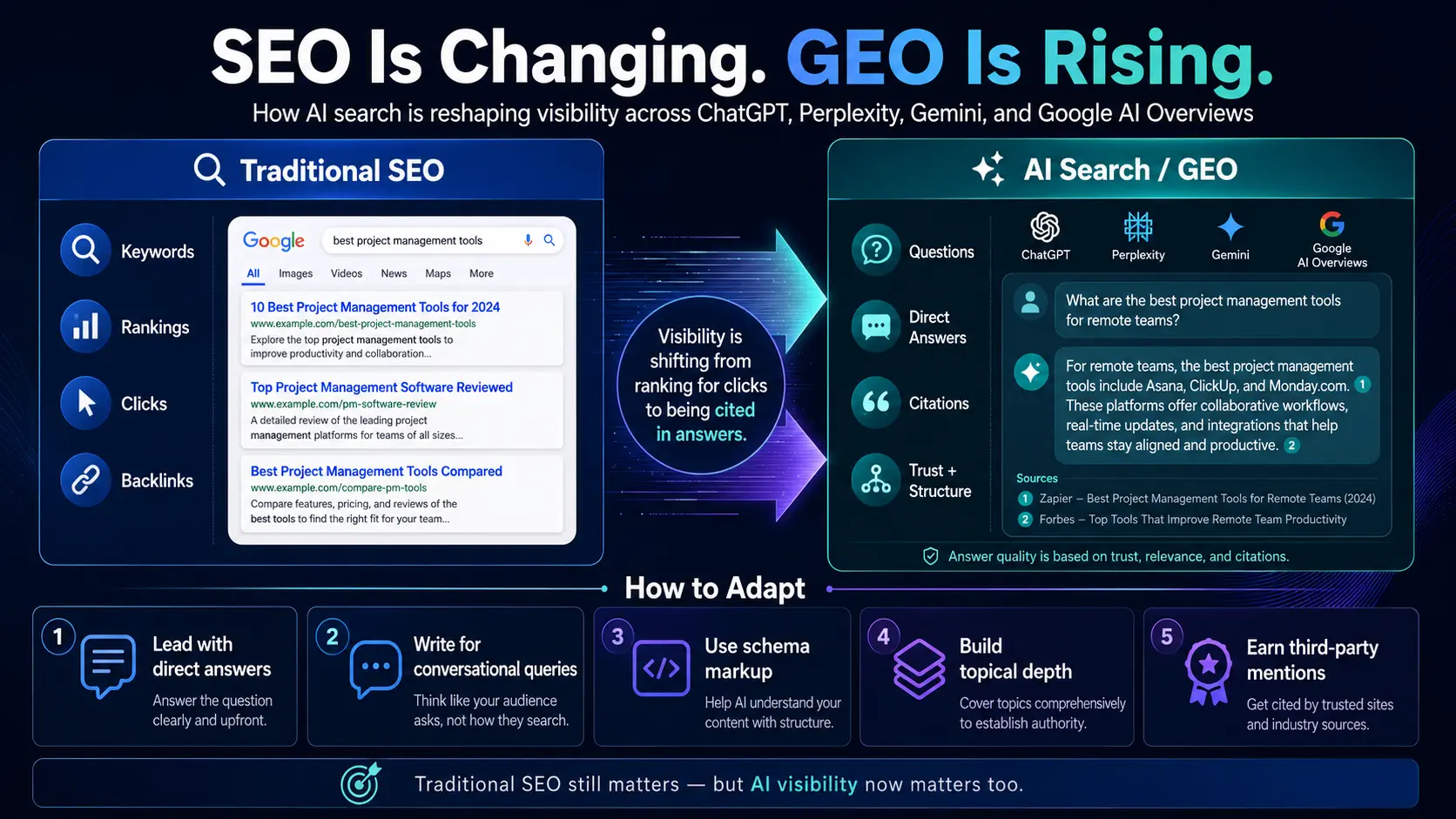
Search doesn't look the way it did even eighteen months ago. Instead of typing a few keywords into Google and clicking through blue links, more and more people are asking full questions directly to ChatGPT, Perplexity, and Google's AI Overviews — and getting a complete answer without ever visiting a website. For a marketing or branding agency, this isn't a minor algorithm update. It's a structural shift in how visibility is earned.
The businesses that show up inside these AI-generated answers are capturing attention (and trust) before a user ever reaches a traditional search results page. The businesses that don't are becoming invisible, even if they still rank well on Google. This post breaks down what's actually changing, why old SEO tactics alone aren't enough anymore, and how to build a content and technical strategy that earns visibility across both traditional and AI-powered search.
What's Actually Changing in Search
Three shifts are driving this new landscape:
AI assistants have gone mainstream. ChatGPT, Gemini, and Meta AI now collectively reach well over a billion active users, and AI answer engines are no longer a niche behavior — they're a default way people research purchases, compare options, and get quick answers.
Ranking #1 on Google no longer guarantees visibility. Research tracking overlap between top Google rankings and AI Overview citations has found the two lists diverge sharply — a large majority of the sources cited inside AI answers are not the same pages sitting at the top of Google's organic results. AI systems are pulling from a different pool, using different logic.
Clicks are being replaced by citations. When an AI engine answers a question directly, many users never click through to a website at all. Being mentioned inside the answer is becoming as valuable — sometimes more valuable — than ranking for the click.
This is why a new discipline has emerged alongside traditional SEO: Generative Engine Optimization (GEO), sometimes called Answer Engine Optimization (AEO). Where classic SEO optimizes for ranking position, GEO optimizes for being extracted, quoted, and cited inside an AI-generated answer.
Why Traditional SEO Alone Isn't Enough Anymore
Traditional SEO still matters — technical health, backlinks, keyword targeting, and site structure remain the foundation. But AI engines evaluate content differently than Google's classic ranking algorithm:
They reward clarity over cleverness. AI systems extract answers, so content written in dense, marketing-heavy language is harder to lift and cite than content that states a clear, direct answer up front.
They weigh trust signals beyond backlinks. Being mentioned across credible third-party sites, review platforms, and industry publications matters as much as — sometimes more than — traditional link-building.
They favor structure that's easy to parse. Clear headings, direct answer blocks, comparison tables, and well-implemented schema markup all make it easier for an AI system to lift accurate information from your page.
Each platform behaves differently. Perplexity behaves like a research engine, actively citing sources and favoring recent, well-sourced, long-form content. ChatGPT tends to reward comprehensiveness and established authority. Google's AI Overviews lean heavily on structured data and demonstrated E-E-A-T (Experience, Expertise, Authoritativeness, Trustworthiness).
The takeaway: you're no longer optimizing for one algorithm. You're optimizing for several distinct systems that each decide "who's worth quoting" in their own way.
How to Adapt Your SEO Strategy for AI Search
1. Lead With Direct Answers
Structure key pages so the first paragraph after a heading directly answers the question implied by that heading. AI systems extract concise, self-contained answers far more easily than content that builds up to a point over several paragraphs.
2. Write for Conversational, Full-Sentence Queries
People don't ask ChatGPT or Perplexity the way they type into Google. Instead of fragmented keywords like "best CRM small business," they ask full questions: "What's the best CRM for a 10-person small business on a tight budget?" Build content — including FAQ sections — around these natural-language questions.
3. Implement Structured Data (Schema Markup)
Schema helps AI crawlers and Google's AI Overviews understand exactly what your content is, who wrote it, and how it's organized. At minimum, use Article schema, FAQPage schema for Q&A sections, and Organization/Person schema to reinforce authorship and credibility. (See the schema example at the end of this post.)
4. Build Topical Depth, Not Just Keyword Coverage
AI systems favor content that demonstrates real expertise on a topic, not just content that hits a target keyword. Build topic clusters — a strong pillar page supported by several related, interlinked posts — so both Google and AI engines see comprehensive coverage of your subject area.
5. Earn Mentions on Third-Party Sites
Because AI engines pull from a wide pool of sources beyond your own site, getting mentioned in industry publications, comparison articles, review platforms, and directories increases the chances your brand gets surfaced in an AI-generated answer — even on pages you don't own.
6. Keep Content Fresh
Recency is a meaningful signal, especially for research-style engines like Perplexity. Revisit and update cornerstone content regularly rather than publishing once and leaving it untouched.
7. Track AI Citations, Not Just Rankings
Traditional rank trackers don't show whether you're being cited inside ChatGPT or Perplexity answers. Start manually testing your target queries inside each platform, or use an emerging class of AI-visibility tracking tools, to see whether — and how — your brand shows up.
Google SEO vs. AI Search Optimization: Key Differences
| Factor | Traditional Google SEO | AI Search (GEO/AEO) |
|---|---|---|
| Goal | Rank in top positions | Get cited/quoted in the answer |
| Core signal | Backlinks + keyword relevance | Clarity, structure, and third-party trust signals |
| Content style | Keyword-optimized | Direct, conversational, answer-first |
| Success metric | Rankings, organic clicks | Citation share, AI-referred traffic |
| Update cycle | Periodic algorithm updates | Continuous, model-dependent shifts |
The two aren't in competition — most of the groundwork (schema, topical depth, internal linking, technical health) supports both. But a strategy built only for Google rankings will increasingly leave real visibility on the table.
The Bottom Line
AI search isn't replacing traditional SEO — it's running alongside it, and for many brands, it's becoming the higher-leverage channel. The agencies and businesses that adapt now, by structuring content for direct answers, investing in credible third-party mentions, and implementing proper schema, will be the ones showing up when their future customers ask ChatGPT or Perplexity for a recommendation. The ones that don't will keep chasing Google rankings while their competitors quietly win the conversation happening inside AI assistants.
Frequently Asked Questions
What is Generative Engine Optimization (GEO)?
GEO is the practice of structuring content so AI platforms like ChatGPT, Perplexity, Gemini, and Google AI Overviews can easily extract, trust, and cite it when answering a user's question.
Is GEO replacing traditional SEO?
No. GEO runs alongside traditional SEO rather than replacing it. Most of the technical and content foundation — schema, site structure, topical authority — supports both.
How do I know if my content is being cited by AI search tools?
Manually test your target questions inside ChatGPT, Perplexity, and Google's AI Overviews to see which pages get cited, or use an AI-visibility tracking tool designed for this purpose.
Does Perplexity work differently than ChatGPT for SEO?
Yes. Perplexity behaves more like a research engine and visibly cites its sources, favoring recent, well-sourced, long-form content. ChatGPT tends to weigh overall authority and comprehensiveness more heavily.